The Solicitors Qualifying Exam (SQE): everything you need to know
updated on 17 February 2026
Here's everything you need to know about the Solicitors Qualifying Exam (SQE) assessments, from the syllabus to the format of the exams themselves, to the cost for candidates, to what law firms, universities and law schools are doing.

Recent SQE updates in the news
- SQE2 results rise slightly in latest results
- SQE pass rate drops to record low of 41%
- SRA awards £360,000 to support disadvantaged candidates taking SQE
- Petition calls for SQE reform amid concerns over candidate wellbeing and transparency
Why did the SQE replace the LPC?
How has the SQE affected people already studying a law degree, GDL or LPC?
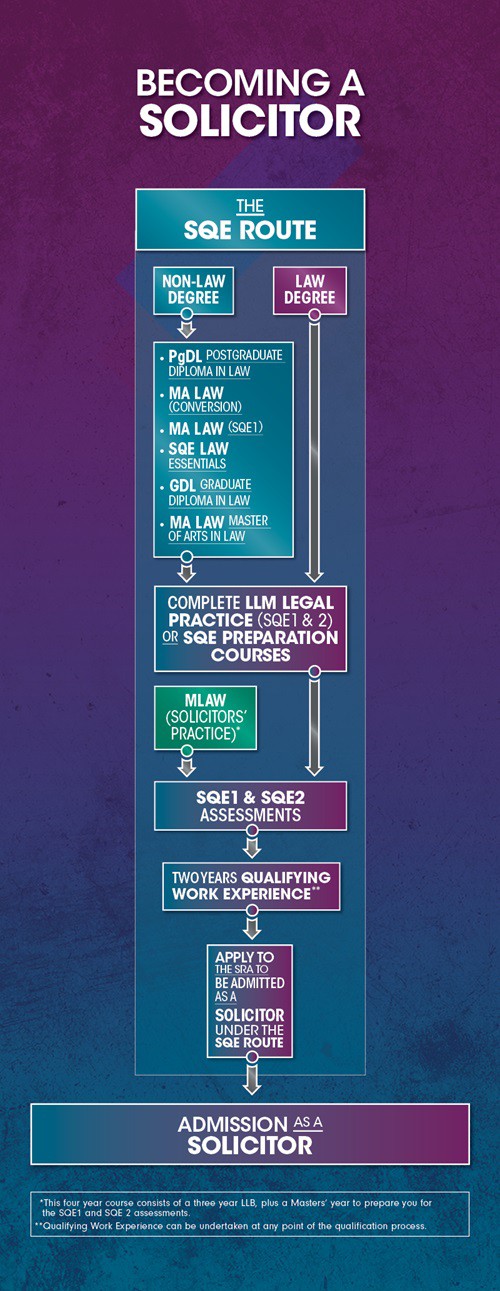
How do I qualify as a solicitor under the SQE?
Qualifying through the SQE: what do I need to do and when?
Where and when do SQE assessments take place?
Your route to becoming a solicitor
What's the SQE?
The SQE is the centralised assessment that all aspiring solicitors must pass to qualify. It was introduced in September 2021 and has replaced the Legal Practice Course (LPC). There are transitional arrangements in place between now and 2032 – you can read more on these below. Many course providers have stopped offering the LPC, so do your research to understand your options.
The SQE is divided into two stages, with SQE1 covering functioning legal knowledge; and SQE2 focusing on practical legal skills and knowledge. The new system of exams was introduced by the Solicitors Regulation Authority (SRA) and is being provided by Kaplan
Why did the SQE replace the LPC?
The SRA designed the SQE with the aim of ensuring consistent, high standards for all qualifying solicitors while introducing increased flexibility. So, while all aspiring solicitors must now pass the same centralised assessment to qualify, the SQE enables solicitor apprentices to qualify in six years by combining study with on-the-job training, while SQE students and graduates working as paralegals can qualify as solicitors by completing the SQE.
In short, the SQE is now the final, centralised assessment at the end of all these different pathways to ensure that all qualifying solicitors are tested consistently, regardless of the route they’ve taken.
In recent years, the SRA’s efforts to introduce more routes to qualifying have been aimed at increasing competition and innovation among universities, as well as widening access to careers in the profession. The SQE is intended to further increase flexibility by keeping the current system’s requirement to complete two years’ legal work experience (now referred to as ‘qualifying work experience’ (QWE)), but making it possible for volunteering roles and placements through university to count towards the total (as well as paralegal experience, much like equivalent means).
How has the SQE affected people already studying a law degree, GDL or LPC?
There are still opportunities to qualify via the LPC if you meet certain criteria. According to the SRA, candidates can qualify via the LPC route if they:
- have completed the Graduate Diploma in Law (GDL) or Common Professional Examination (accepted before 1 September 2021).
- had accepted an offer for a qualifying law degree (QLD) or exempting law degree (ELD) by 21 September 2021 and started the course before 31 December 2021 (and have now graduated);
- deferred their 2020/21 QLD or ELD offer but started the course by 31 August 2022 – evidence of the deferral will need to be provided.
The SRA also confirms that if you began a QLD in September 2022 or later, you’re not eligible for the LPC transitional arrangements and must instead qualify through the SQE route.
Candidates who are eligible to qualify via the LPC but want to make use of the flexibility that the new QWE requirement allows can do so; however, they must also take and pass SQE2. This will mean additional costs incurred (ie, LPC fees, plus SQE2 assessment costs and any preparation required).
Although the LPC will remain a valid alternative to the SQE until 2032, some universities are no longer providing the LPC. The SRA notes that there are only a few providers authorised to deliver the LPC in 2026/27. In addition, law firms across the country began adopting the SQE in various ways, including recruiting a hybrid cohort of trainees, consisting of LPC and SQE applicants.
It’s important that you check what your shortlisted firms are doing in this regard, so you know what’s expected of you.
Find out whether law firms are still recruiting LPC graduates.
How do I qualify as a solicitor under the SQE?
There are four requirements to qualify as a solicitor via the SQE. You must:
- have a university degree or equivalent in any subject (law or non-law);
- pass the SRA’s character and suitability assessment;
- pass SQE1 and 2; and
- have two years’ QWE.
Qualifying through the SQE: what do I need to do and when?
The SQE is a graduate assessment, so you'll first need to complete a degree (law or non-law) or equivalent.
While the rules on when you complete the SQE and QWE requirements offer real flexibility, many law firms will have preferences because most want to train you themselves. However, the SRA doesn’t stipulate any requirements in this regard, other than that the SQE1 must be completed before SQE2. QWE can be completed before, alongside or after SQE1 and SQE2.
Following the first attempt at SQE1, candidates then have six years in which to complete both parts of the assessment – and can attempt SQE1 and SQE2 three times each. Candidates must have also completed their two years of QWE before they apply for admission to the roll of solicitors.
Find out how the SQE has impacted training contracts.
What's QWE?
QWE can be undertaken before, during and/or after completing SQE1 and SQE2, at up to four organisations such as law firms, law centres and university pro bono clinics.
Find out what counts as QWE to see the kinds of work you can do.
A single placement doesn't have to be a minimum length of time – the two-year total just needs to be completed within the maximum of four separate periods of QWE.
Each placement must be signed off by a solicitor at the organisation, compliance officer for legal practice, or failing the first two, another solicitor outside the organisation with direct experience of the candidate’s work. It's up to the confirming solicitor to decide whether the QWE meets the SRA's requirements.
QWE isn’t assessed by the SRA, unlike SQE1 and 2. But as SQE2 tests practical skills, QWE should involve candidates learning the skills they'll need to pass SQE2.
Find out more about how to get your QWE accredited via The Oracle!
There’ll no longer be a requirement for trainee solicitors to work in a specific number of different areas of law, or experience both contentious and non-contentious practice areas.
Many law firms are continuing recruit via the traditional two-year training contract and aren’t obliged to shorten the period of training they offer if a candidate has already gained some experience. Plus, many firms have specific training programmes that prepare solicitors for life within a specific specialism, working environment and client base. It’s worth checking, but most of these firms will also provide funding for the SQE – for example, if you’ve secured a training contract with RPC, you’ll be required to complete the SQE assessments before starting the training contract. Future trainees will need to complete the Postgraduate Diploma in Law (if you’re from a non-law background) and the LLM Legal Practice (SQE1&2) at The University of Law. The firm has stated that it’ll provide bursaries for the course fees, the assessments and a maintenance grant up to £12,000.
The graduate solicitor apprenticeship is another alternative way that aspiring solicitors can qualify via the SQE – for example, as part of its apprenticeship offering, CMS’s graduate solicitor apprenticeship, open to law graduate students, will work in a similar way as a traditional training contract, enabling students to have their SQE funded, alongside their training. The firm’s future generations of junior lawyers will join a graduate solicitor apprenticeship programme, working at the firm alongside studying for the SQE at The University of Law.
If you’re a non-law student, Michelmores LLP offers a graduate solicitor apprenticeship available for graduates of any degree subject with SQE funding, subject to the firm’s bursary agreement.
Discover the difference between a solicitor and graduate apprenticeship.
Plus, we outline the differences between training contracts and graduate solicitor apprenticeships in The Oracle.
Do you have more questions about QWE? This LCN Says addresses a number of FAQs that we’ve recently encountered.

What does the SQE cover?
The SQE is split into two stages – SQE1 and SQE2.
SQE1
The first stage, SQE1, covers 'functioning legal knowledge' (FLK). It tests not just your knowledge of the law, but how you’d apply it in real-life situations as a solicitor.
Find out what to expect from the SQE assessments.
SQE1 is made up of two exams, each containing 180 multiple-choice questions that test how candidates would apply their legal knowledge, research and writing skills in real scenarios across different practice areas.
The first 180-question exam covers:
- business law and practice;
- dispute resolution;
- contract;
- tort;
- legal system of England and Wales;
- constitutional and administrative law and EU law; and
- legal services.
The second SQE1 exam covers:
- property practice;
- wills and the administration of estates;
- solicitors accounts;
- land law;
- trusts; and
- criminal law and practice.
The SRA has released these SQE1 sample questions to show candidates the type of questions you can expect on the FLK1 and FLK2 assessments
Find out about the latest SQE1 pass rates via LCN’s News.
SQE2
SQE2 covers 'practical legal skills' and involves both oral and written assessments across five half days. The emphasis on the everyday skills of lawyering, such as drafting contracts and interviewing clients, means that it tests many of the same skills as the LPC.
However, a key difference between SQE2 and the LPC is that the SQE tests to the level of a newly qualified (NQ) solicitor, not a trainee solicitor – that is, it tests whether your practical skills are at the standard required of an NQ solicitor. A candidate’s ethics and professional conduct will also be tested throughout the SQE2.
SQE2 assesses the following six key skills:
- client interviewing and attendance note/legal analysis;
- advocacy;
- case and matter analysis;
- legal research;
- legal writing; and
- legal drafting.
These skills are assessed across five practice areas:
- criminal litigation: criminal liability;
- dispute resolution: contract law and tort;
- property practice: land law;
- wills and intestacy, probation administration and practice: trusts; and
- business organisations, rules and procedures: contract law.
SQE2 is made up of 16 practical exercises (four oral skills assessments and 12 written skills assessments) covering the six areas of law above. It's a uniform assessment, meaning that all students sit the same exam. The 16 exercises take place over multiple days but result in one overall mark. SQE2 oral will take place over two half days and SQE written will take place over three half days.
Where and when do SQE assessments take place?
Students can sit SQE1 and 2 written assessments at their nearest Pearson test centre in the UK and internationally (where driving theory tests in England and Wales take place). SQE2 oral assessments are available to take in Birmingham, Cardiff, Manchester and London with the written assessments available to take at Pearson VUE locations in the UK and internationally. There’ll be multiple exam sittings throughout the year, providing flexibility to students, law schools and employers.
FLK1 and FLK2 must be taken in the same assessment window unless a candidate has an exemption. The SRA is encouraging aspiring lawyers to register for the SQE1 exams set to take place in January and July of each year.
According to the SRA website, SQE2 written assessments will take place in January, April, July and October.
You can check the SRA’s dates and locations page for the most up-to-date information regarding the exam arrangements.
Please note: to book an assessment you must first register as an SQE candidate.
How much does the SQE cost?
The cost of taking the SQE from September 2025 onwards is £4,908. This is broken down into:
- SQE1 – £1,934; and
- SQE2 – £2,974.
These figures don't include the SQE preparation courses that candidates should take before attempting the exams. LCN has created a guide to SQE preparation courses, which includes the costs and course content on offer at different law schools and universities.
You can also search for SQE prep courses via LCN’s Courses search function.
While there are plenty to choose from, the cost of some of the SQE prep courses has been criticised. The Junior Lawyers Division (now the Junior Solicitors Network) previously expressed concern that the overall costs of completing the ‘super exam’ is likely to rival, if not exceed, the costs of the LPC. For example, at the top end courses could cost between £15,000 to £19,000 (excluding the exam fees) – similar to the cost of the LPC. That said, at the lower end some providers are offering less expensive alternatives, which could see the total cost of the SQE (including exam fees) come to around £11,500 – a significantly lower figure than the LPC. The price of these courses will reflect the material candidates will have access to, as well as contact time with tutors and the type of course (eg, LLMs will be significantly more expensive than a standalone SQE1 or SQE2 prep course), for example.
As mentioned briefly above, there are funding options available for the SQE depending on the way a candidate chooses to complete the prep courses and training. For example:
- various optional SQE preparation courses provided by different law schools will include the option to combine with a master’s, making them eligible for the postgraduate loan in the same way as the GDL and LPC; and
- some training providers (ie, the law firms) will offer funding for their trainees in much the same way as they’d previously done for the LPC.
You can find out more about funding the SQE preparation courses via The Oracle.
SQE preparation courses
It's not compulsory to complete a preparation course to take the SQE. However, given that aspiring solicitors can attempt each part of the assessment only three times in the six-year period from the date they first sit an SQE assessment, candidates will likely choose to complete a prep course to give themselves the best chance of passing. Plus, if you’ve secured a training contract with a firm, they'll most likely require you to take a preparation course before attempting the assessments.
A range of postgraduate SQE1 and SQE2 preparation courses are available at providers such as BARBRI, BPP, The University of Law, QLTS School, Nottingham Law School and The College of Legal Practice. There are full-time and part-time study options available depending on your circumstances.
Find out more about The University of Law's SQE prep courses today.
If you’re a non-law student, there are specific SQE preparation courses available that incorporate the PGDL/GDL, or aspects of it.
To find out more about whether you need to take a law conversion course before embarking on the SQE as a non-law student, read this Oracle.
The University of Law’s LLM Legal Practice (SQE1&2) – a course designed to prepare students for both stages of the SQE – will cost between £15,150 and £18,850 (for 2026/27), depending on location and excluding the fees to take the SQE assessments. The University of Law has several other SQE prep courses on offer, including its MA Law (SQE1), which is designed for non-law graduates; it acts as a law conversion course and includes SQE1 preparation.
Find out how Rachel Hii found preparing for the SQE with The University of Law via this LCN Says and discover more prep courses via LCN’s guide to SQE preparation courses.
At undergraduate level, students may also have the option to undertake a modified law degree that combines SQE1 preparation with the traditional LLB.
The new courses provide a variety of options and a range of different fee levels and learning styles, but at the top end of the fees scale, early promises that the SQE would make becoming a solicitor more affordable than the LPC route have so far not been fully realised.
LCN’s advice to you is to speak to law firms to find out what they expect from you, when you need to have completed the assessments and whether you’re required to build up your QWE with your shortlisted firms as part of a training programme. Make sure you also regularly check LCN’s SQE hub, sponsored by The University of Law, for the most recent updates.
Your route to becoming a solicitor