
European debt markets defy geopolitical turmoil
updated on 21 September 2026

Question
Can Europe’s leveraged finance market continue to defy geopolitical disorder?Answer
Summary: Europe’s leveraged finance market has remained resilient despite geopolitical shocks, including conflict in Iran and volatility linked to AI disruption. Strong liquidity and rapid repricing have allowed large transactions to proceed, while borrowers increasingly prioritise transaction certainty over pricing concessions. Issuers are engaging lenders earlier and adopting more flexible financing strategies, combining private credit, syndicated loans and high-yield bonds. With deal pipelines remaining strong and investor demand intact, market participants expect activity to stay robust through the remainder of 2026.
Europe’s leveraged finance market has withstood major geopolitical volatility and continues to reprice rapidly, bringing large deals to market. Dealmakers are emphasising pre-deal preparation and early engagement with lenders to increase transaction certainty. Traditional financing product silos are breaking down, with issuers increasingly using combinations of private credit, syndicated loans and high-yield bonds to secure the best financing package.
The theme that characterised European leveraged finance through the first half of 2026 was the market’s capacity to adapt to geopolitical shocks. There have been plenty to navigate: US airstrikes on Venezuela in January; early February’s US $300 billion sell-off in software stocks, fuelled by AI disruption; and the outbreak of a major conflict in Iran just a few weeks later, which caused oil prices to spike by more than 50%.
Yet, in the face of this disruption, Europe’s debt markets have shown a remarkable ability to adjust without breaking. According to Debtwire, leveraged loan issuance in Europe reached €214.8 billion through the first six months of 2026, up 6% year-on-year. In the high-yield market, €50.8 billion worth of bonds were issued during the same period, down 31% year-on-year.
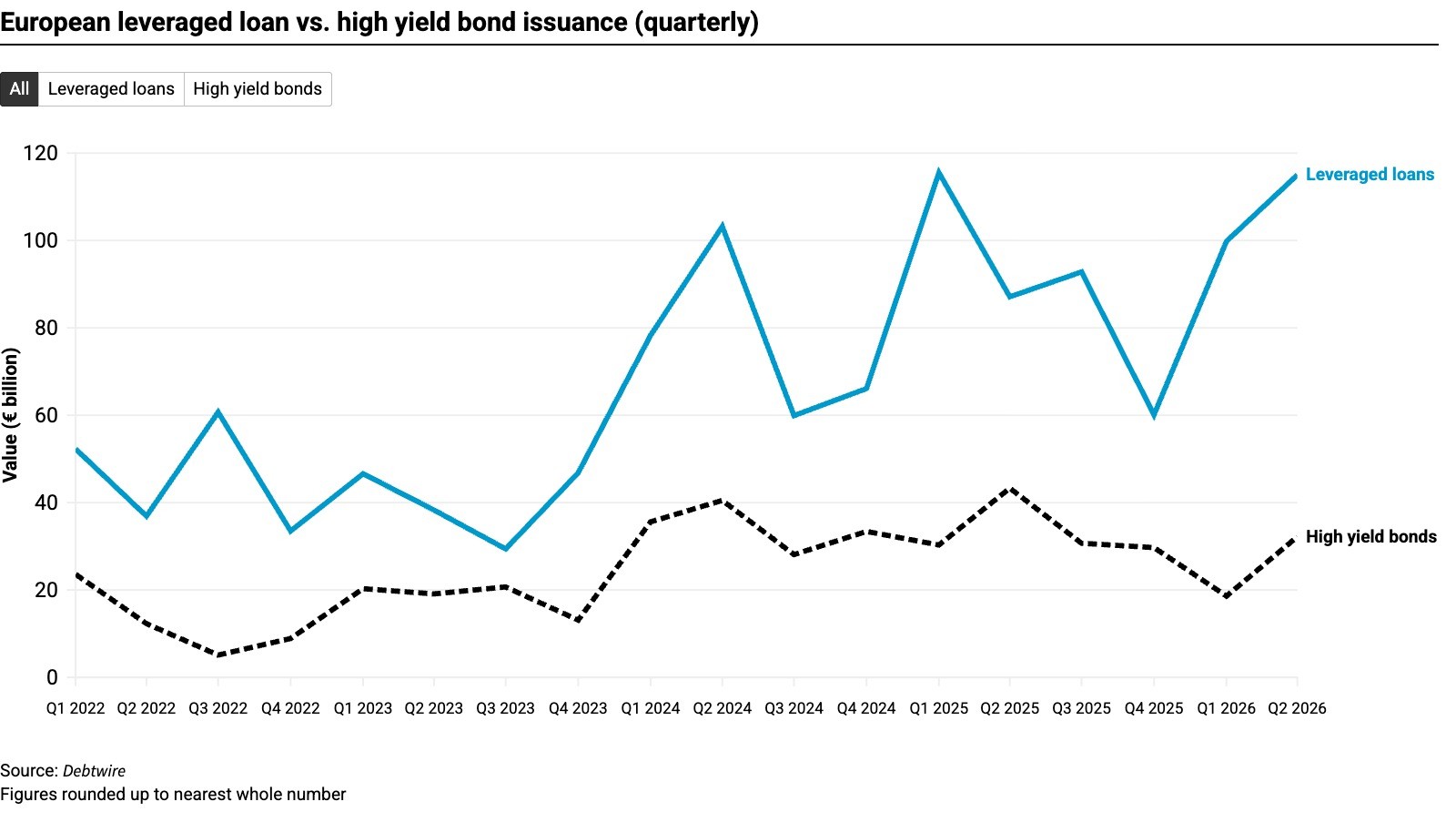 Borrowers with strong credentials have demonstrated confidence when bringing deals forward for financing. Deals launched in recent weeks include a €1.7 billion financing for Triton’s acquisition of Flender, a German gearbox manufacturer, and a €3.9 billion financing for the acquisition of BASF’s coatings business by Carlyle and the Qatar Investment Authority.
Perfect timing
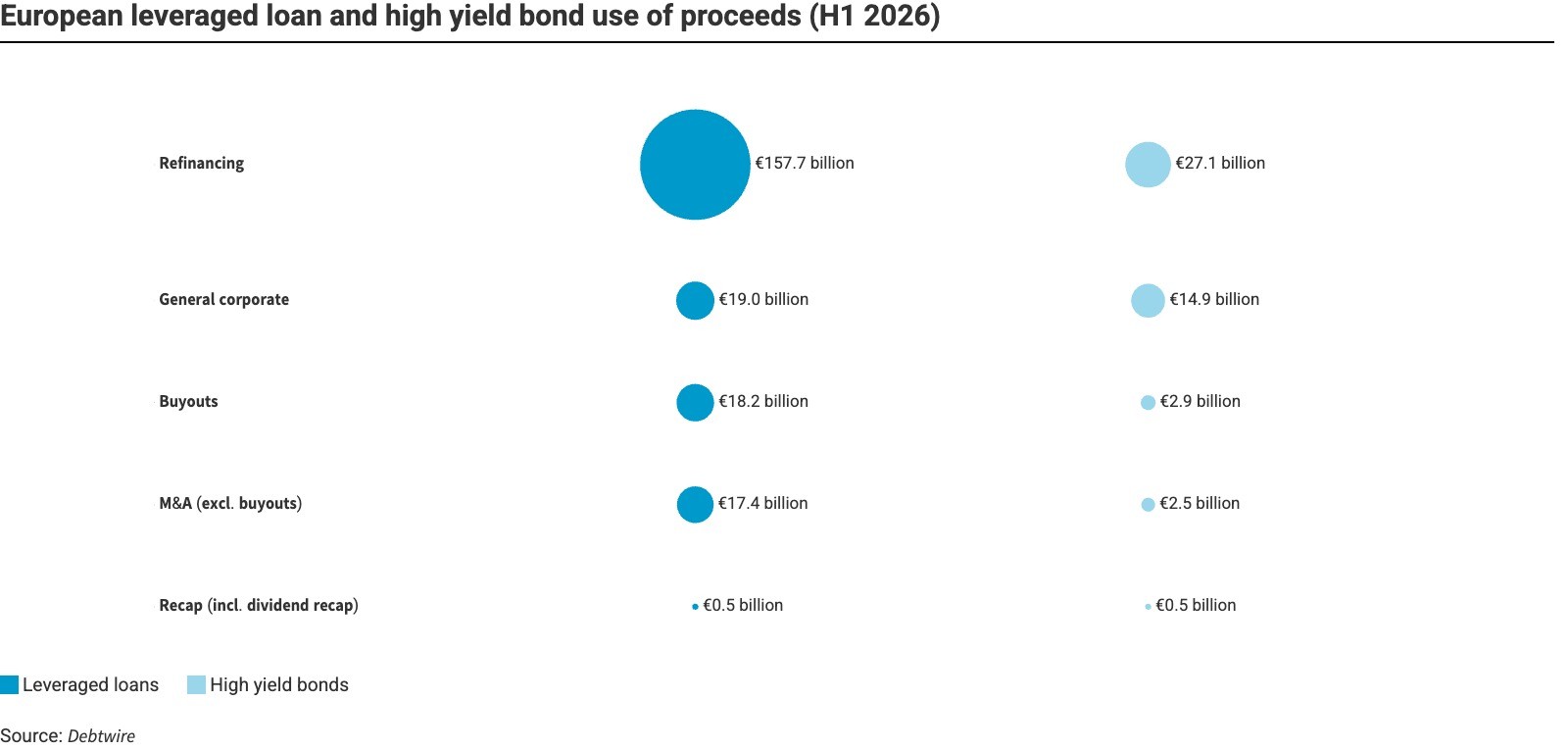
During a period when volatility has become almost structural, issuers and their advisers have successfully moved deals forward by focusing on launch timing and pre-deal preparation. Indeed, the biggest impact of global events has been on deal timing rather than transaction viability. When issuers launch in a favourable market window, underlying transactions have typically proceeded with no changes to the terms or documentation. Even dividend recapitalisation deals, which are usually a feature of bull markets, have found success when windows of opportunity have opened. Real estate investment trust Befimmo, IT services company Lutech and French pharmaceutical company Cooper Consumer Health are among the issuers to close dividend recapitalisations in 2026.
Valuation uncertainty constrained M&A markets through the first half of the year, but debt markets have remained highly supportive. Issuers faced with challenging exit conditions have been able to hold assets for longer and unlock liquidity through dividend recapitalisations. Confidence in the availability of liquidity, whether for dividend recapitalisations or other uses of proceeds, has sustained activity through the recent uncertainty and the market appears well positioned for additional financings.
 Issuer priorities change
Although there’s momentum in the market, the macroeconomic backdrop has shifted issuers’ mindset and, as a result, their priorities have changed. For all borrowers, the crucial factor now is transaction certainty rather than pushing for incremental improvements to documentation, pricing and terms.
There’s been a bifurcation in the market when it comes to negotiating pricing and documentation. High-quality borrowers have more room to push for better terms, whereas more complex borrowers are aiming simply to secure capital. However, even borrowers with stronger credits are placing greater emphasis on deliverability. They’re in a relatively strong position; for many high-quality issuers, transactions already contain more flexibility than they’re likely to require.
The focus on deliverability and execution has seen borrowers and underwriting banks put more time into engaging early with lenders to ensure that launch windows are optimised. According to Bloomberg, premarketing a deal before the official launch is becoming increasingly common. Banks are ensuring that investors are well-briefed and that sufficient commitments are in place to cover financing before the formal syndication processes begin.
Structures straddle product silos
European financing markets, on both the borrower and lender side, have shown an ability to reprice rapidly as the macroeconomic picture changes. Activity no longer shuts down for prolonged periods following market shocks. Instead, participants are adjusting their assumptions quickly and continuing to execute transactions.
Financing for software assets presents one case in point. Investors briefly paused issuance for software borrowers to assess the implications of the sector sell-off in stock markets. However, within just a few weeks, software deals had returned to lenders’ radars. In early June, for example, French software company Cegid was able to secure a €1.1 billion loan from private credit lenders Arcmont and Ares.
The ability of markets to adapt and adjust quickly has seen issuers proactively move between different products to secure the best possible financing structures and pricing for deals. For example, European leveraged finance borrowers have switched from higher-priced floating rate loans to fixed-rate high-yield bonds to cut financing costs and hedge against potential interest rate increases in case inflation rises due to volatile oil prices, according to Bloomberg. French care home business DomusVi and equipment rental company Kiloutou are among the issuers who, in recent months, have opted to refinance syndicated loans with high-yield bonds.
These developments underscore how the traditional silos of private credit, syndicated loans and high-yield bonds are breaking down, with dual-track processes becoming more popular. Issuers increasingly see these products as complementary and will pick financing that presents the best combination of execution certainty, maturity profile, cost and structure.
It’s also becoming more common for borrowers to use different products at different points in the financing cycle. For example, sophisticated borrowers will initially leverage the execution certainty of a private credit facility to secure financing, but will have a plan to use this as a bridge to refinance with lower-cost syndicated loans or high-yield bonds when favourable issuance windows open in these markets.
Building momentum
Confidence in the depth of the European leveraged finance markets was the principal driver of activity in the first half of the year and will continue to define the market through the rest of the year.
For issuers, the key predictors of whether a financing is likely to proceed are not macroeconomic forecasts or the interest rate outlook. The market has shown its capacity to react swiftly to external events, reprice and remain open for business. What’s most important is momentum. If syndications are successful and large transactions clear the market, confidence builds and additional issuance follows. Pipelines for the second half of the year are already full, but these deals were underwritten months ago. Issuers will be closely monitoring how these transactions progress through syndication. If they proceed smoothly, more deal flow will enter the market.
The positive news is that, as things stand, syndications for deals that are in the pipeline and already underwritten are expected to go ahead successfully. A lack of new-money supply has been a defining feature of leveraged finance markets in recent years, and the pool of higher quality credits remains relatively shallow. This suggests the market still has significant capacity to absorb new supply. As long as investors continue to provide liquidity, conditions for issuers are set to remain positive.
Gareth Eagles is a partner at White & Case LLP.
