
The HSE’s approach towards its regulatory activities
updated on 09 February 2026

Question
How does the HSE decide what to focus on? (Using the example of the HSE’s focus on work-related ill health, specifically mental health and stress)Answer
The Health and Safety Executive (HSE) is a regulator, established in 1975, covering Great Britain’s workplace health and safety. It prevents work-related death, injury and ill health. The HSE is an executive non-departmental public body, sponsored by the Department for Work and Pensions.
The Health and Safety at Work Act etc 1974 (HSWA) established the HSE and is the main law governing the safety at work in Great Britain. The legal framework set by the HSWA and associated legislation is what the HSE’s regulatory approach operates within.
Examples of the workplaces in which the HSE is responsible for enforcing health and safety include:
- factories;
- mines;
- schools and colleges;
- fairgrounds;
- hospitals and nursing homes; and
- offshore installations.
However, its remit is more than simply enforcing non-compliance of health and safety legislation. It also includes, but isn’t limited to:
- advising ministers on legislation;
- organising consultations on all proposals to change legislation or policy decisions, which will have the force of law;
- working with other regulators nationally and internationally;
- providing guidance, advice and information surrounding health and safety;
- inspecting dutyholders;
- providing training and events;
- assessing reports of issues and incidents and taking proportionate action,which includes inspection, investigation and enforcement;
- communicating the most serious enforcement actions; and
- conducting research.
The HSE’s policymaking isn’t decided in a silo. It’s informed by its expert scientific and technical input and is a cooperative decision-making process. The regulator uses its research to build the evidence base to support and inform its regulatory activities.
The HSE’s Protecting people and places: HSE strategy 2022 to 2032 outlines its mission, vision and values, as well as its strategic objectives. Its mission is to protect people and places and its strategic objectives concentrate its “work on areas of greatest health and safety challenge and where [they] can make the biggest contribution to benefit society”. One of these objectives is reducing work-related ill health, with a specific focus on mental health and stress.
Work-related stress, depression and anxiety
In recent years, the HSE has been focused on work-related stress, depression and anxiety. ‘Stress’ is defined by the HSE as “a harmful reaction that people have to undue pressures and demands placed on them at work”.
The HSWA places a duty on employers to ensure, so far as is reasonably practicable, the health, safety and welfare at work of all its employees. This duty includes physical and mental health. Therefore, when an employer conducts a risk assessment of the risks to the health and safety of its employees, work-related stress needs to be taken into consideration.
Although the HSE has covered work-related stress previously (eg, in 2004, with the release of the Management Standards), it could be argued that the perception was that the HSE focused on physical health and physical injuries within the workplace.
However, it’s now clear that other work-related ill health, specifically mental health and stress, is firmly on the regulator’s radar.
In November 2021, the HSE launched the Working Minds campaign to raise awareness of an employer’s legal duty to prevent stress and support good mental health. The campaign hinges around the principles of risk assessment and focuses on five steps:
- Reach out and have conversations.
- Recognise the signs and causes of stress.
- Respond to any risks you’ve identified.
- Reflect on actions you’ve agreed and taken.
- Make it Routine to check in on how people are feeling and coping.
Since then, as explained above, the HSE outlined one of its strategic objectives for 2022 to 2032 was to reduce work-related ill health, with a specific focus on mental health and stress.
In May 2025, the HSE published its business plan for 2025/2026 and, again, it referred to this objective and provided priorities regarding work-related ill health. One of these priorities was “building an evidence base”. The business plan explained that “[e]vidence from the [HSE’s] research programme will help identify practical measures for addressing work-related stress and build an understanding of the complexities of mental health at work”. This priority ties in with the HSE’s approach to reducing work-related ill health (see diagram below).
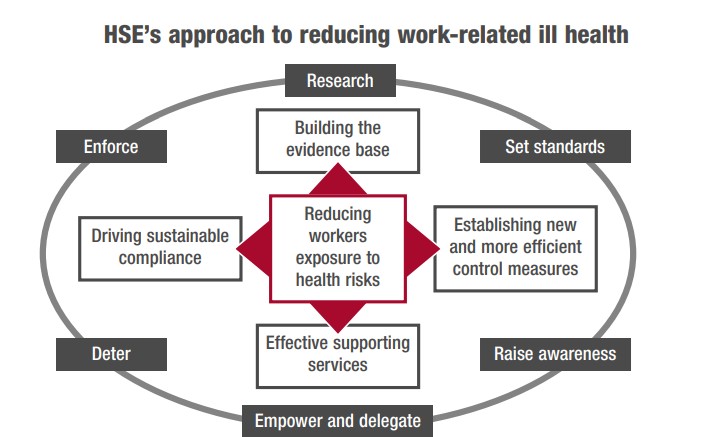
The priority of “building an evidence base” and the HSE’s approach emphasises how research and evidence are the building blocks for the actions that the regulator takes to work-related ill health.
Although it may seem that the actions taken so far relate to providing employers with resources and assistance, the HSE has also served notices of contravention. Simply put, a notice of contravention outlines the law a HSE inspector considers to have been broken. In April 2025, a notice of contravention was given to the East of England Ambulance Service; and in December 2025, a notice of contravention was given to the University of Birmingham. Both of these notices concerned the management of work-related stress and outlined actions that each employer needed to take to comply with the relevant legislation.
From the actions above, we can see that the HSE is focusing on work-related ill health, specifically stress and mental health, but why?
How’s work-related stress, depression and anxiety affecting Great Britain?
The rates of workers affected by work-related stress, depression or anxiety (new and long-standing) in recent years have been increasing in Great Britain, shown by the diagram below.
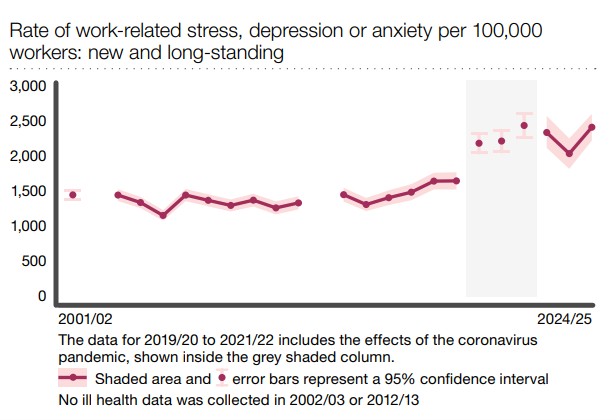
This overall increase is also shown by the following statistics relating to Great Britain:
|
Timeframe |
How many workers suffered from work-related stress, depression or anxiety (new or long-standing)? |
How many working days were lost due to these conditions? |
|
2014/2015 |
440,000 (234,000 new cases) |
9.9 million |
|
2019/2020 |
828,000 (347,000 new cases) |
17.9 million |
|
2020/2021 |
822,000 (451,000 new cases) |
No data available on working days lost. |
|
2022/2023 |
875,000 (338,000 new cases) |
17.1 million |
|
2023/2024 |
776,000 (300,000 new cases) |
16.4 million |
|
2024/2025 |
964,000 (409,000 new cases) |
22.1 million |
These statistics alone are worrying, but what’s also concerning is the position of stress, depression or anxiety within the overall category of work-related ill health. In 2024/2025, 52% of the new and long-standing cases of work-related ill health concerned stress, depression or anxiety (964,000) and 62% of working days lost were due to those conditions.
Looking at these statistics, it’s unsurprising that the HSE is focusing on this. The effect of these conditions not only affects the employee, but also affects the employer and the economy. In 2022, Deloitte estimated that poor mental health cost UK employers up to £51 billion a year and with the number of workers suffering from these conditions increasing, the costs are only going to increase.
How does this focus show the HSE’s approach?
It’s clear that the HSE is placing more focus on work-related ill health, specifically mental health and stress and isn’t shy of outlining to employers that its management of this isn’t good enough. By shining a light on the work the HSE is undertaking on this and the statistics concerning these conditions highlights that the regulator’s approach isn’t decided in a silo, it is informed by evidence and focuses on current challenges affecting workers.
Lauren Crockett is an associate in the construction team at Devonshires.
